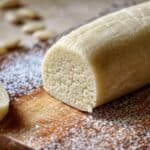
How to Make Almond Paste at Home
Learn how to make almond paste using blanched almonds. Quick, reliable, and ideal for Italian cookies and festive desserts.
Servings 1 serving
Calories 411kcal
Equipment
- food processor
Ingredients
- ¼ cup granulated sugar 50 grams
- ½ cup water 120 mL
- 2 cups blanched almonds 280 grams
- 2 cups powdered sugar 280 grams, divided
- ½ teaspoon almond extract
- pinch of salt
Instructions
- Make the sugar syrup: In a small saucepan, heat the water and granulated sugar over low heat just until the sugar dissolves. Do not boil. Set the syrup aside to cool completely before using.
- Grind the almonds: Add the blanched almonds and half of the powdered sugar to a food processor. Pulse until the almonds are finely ground and the mixture looks like coarse sand.
- Add the remaining sugar: Add the rest of the powdered sugar and pulse again to combine evenly.
- Bring it together: Add most of the cooled sugar syrup, along with the salt and almond extract. Pulse until the mixture starts to clump and hold together. If it still looks dry, add a little more syrup at a time and pulse again. Stop as soon as it forms a soft, pliable paste that holds together when pressed.
- Shape the almond paste: Transfer the paste to a clean work surface and shape it into a log. If it feels sticky, dust lightly with powdered sugar.
- Refrigerate before using: Double-wrap tightly in plastic wrap and refrigerate for at least 30 minutes before using.
- Store for later. Double-wrap the almond paste tightly in plastic wrap. Refrigerate for up to 2 weeks or freeze for up to 3 months.
Video
Notes
Find helpful step-by-step photos in the post and a short video in the recipe card to guide you through the recipe.
Yield: About 2 cups of almond paste (1½ pounds/680 grams)
- Use fresh almonds for the best flavor. Almonds can go rancid over time.
- Cool the sugar syrup completely. If it’s warm when added, the paste can become too soft and sticky.
- Don’t over-process. Pulse the almonds rather than running the processor continuously. This prevents releasing too much oil, which can make the paste greasy.
- Add most of the cooled syrup gradually. The mixture will start crumbly, then come together. If it’s still too dry, drizzle in a little more syrup or water. If it becomes too soft, pulse in extra powdered sugar until the texture feels right.
- Refrigerating helps improve the texture. Resting the paste for at least 30 minutes firms it slightly and makes it easier to handle, especially for cookies and fillings.
- A rubber spatula is your friend. It helps scrape the food processor bowl clean and bring the paste together without overmixing.
- Divide before storing. Shape into smaller logs and freeze individually—much easier to grab just what you need for a recipe later.
- Use almond extract sparingly. A little enhances flavor beautifully, but too much can overpower the natural almond taste.
- Air-dry method: Spread almonds on a tray and leave overnight.
- Quick oven method: Preheat oven to 225–250°F (107–121°C), spread almonds on a cookie sheet, and bake for 3–5 minutes. Let cool completely before grinding.
Nutrition
Serving: 1serving | Calories: 411kcal | Carbohydrates: 15g | Protein: 15g | Fat: 35g | Saturated Fat: 2g | Potassium: 504mg | Fiber: 8g | Sugar: 2g | Calcium: 189mg | Iron: 2.7mg
