

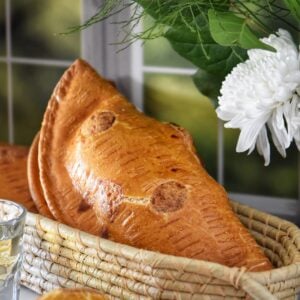
Celebrate Easter Italian style with my family’s recipe for fiadone di formaggio, a savory Italian cheese pie. From the pie crust to the cheese filling, savor the taste of tradition in every bite.
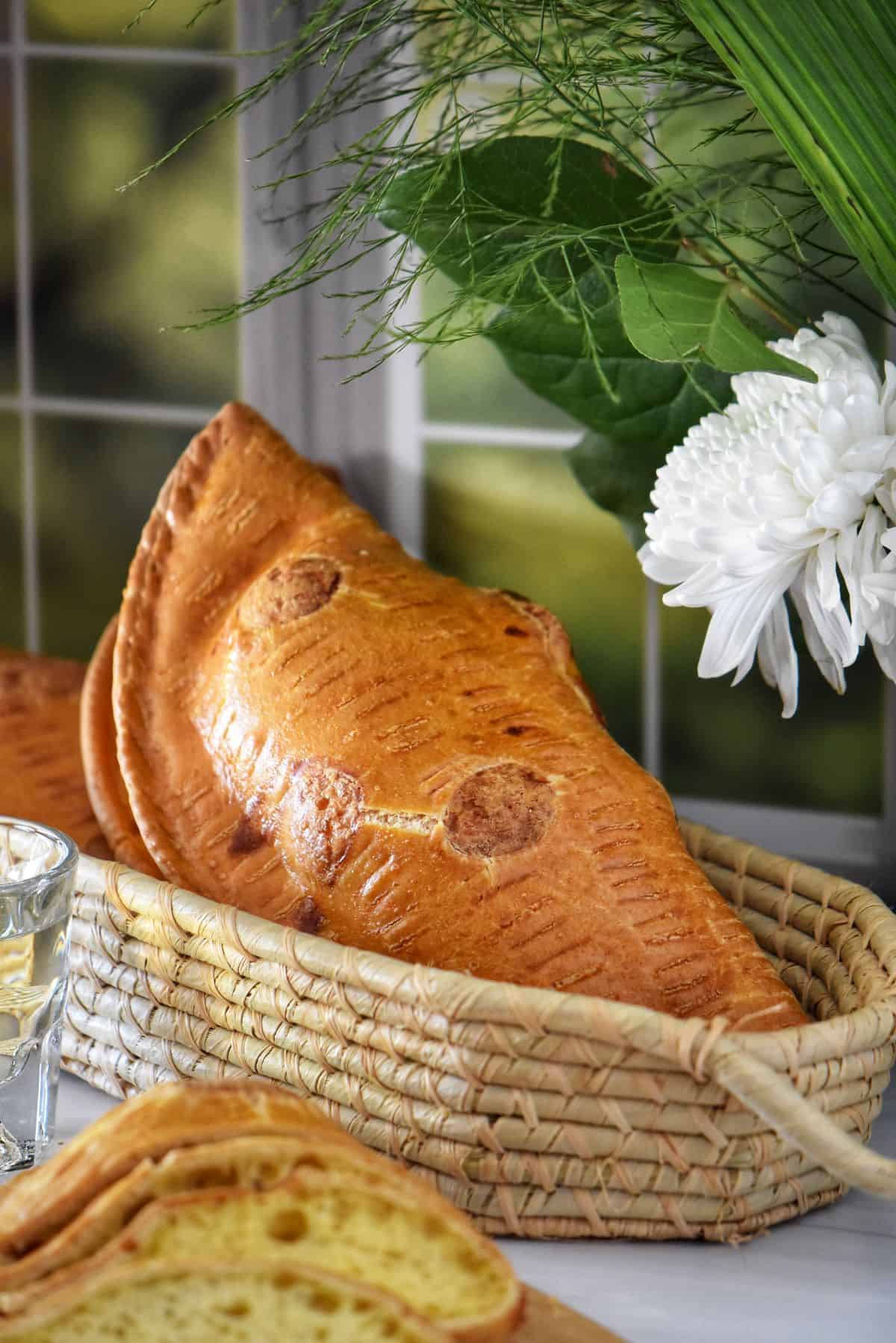
Today, I’m thrilled to share my family’s cherished recipe for savory Italian cheese pies, known as fiadone di formaggio in Italian.
My family’s Easter tradition includes making these delicious rustic pies alongside many other Italian Easter treats, like crescia and pizza rustica.
Growing up Italian, the weeks and days leading up to Easter were a flurry of activity. My mom and Nonna would make dozens of these savory cheese pies, complemented by an equal number of fiadone dolce, or sweet fiadone made with homemade ricotta.
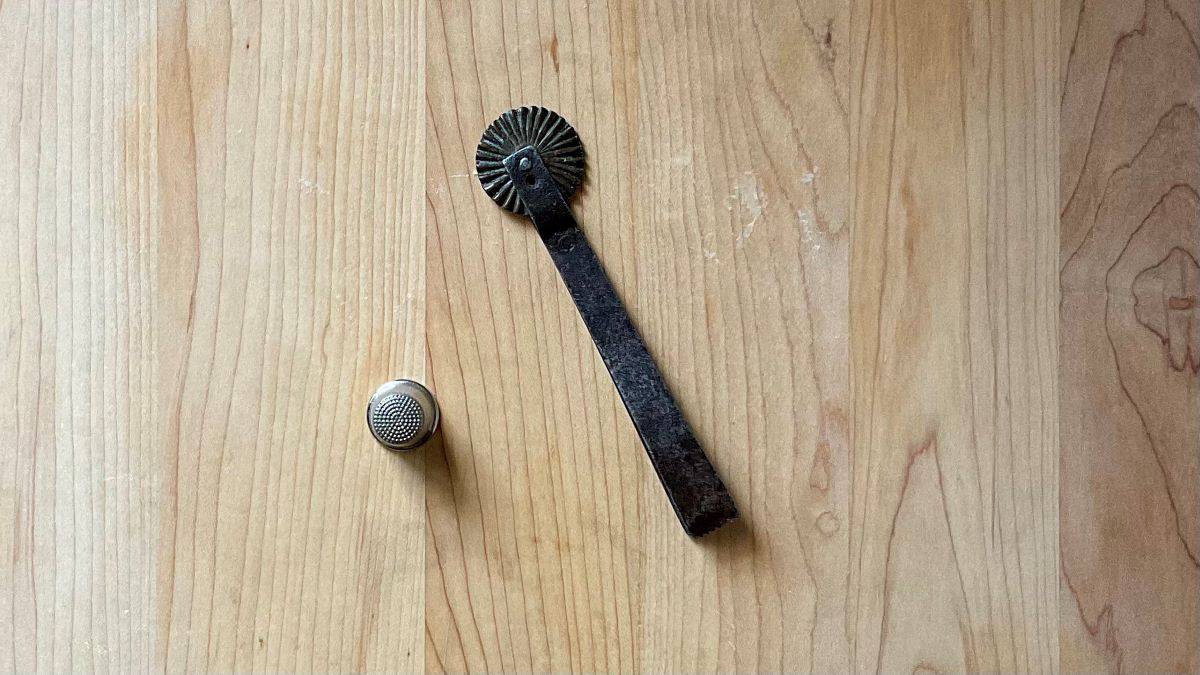
Each family member, including the kids, had their designated role. I fondly recall creating the delicate steam vents in the dough with my grandmother’s trusty thimble. As I got older, I was given the task of “pinching” the dough with my nonna’s pastry wheel.
The perfect blend of savory cheese and eggs nestled within a flaky crust creates a symphony of textures and flavors that is simply irresistible.
Won’t you join me as I share the treasured secrets of my family recipe for this fiadone recipe?
Jump to:
Ingredients
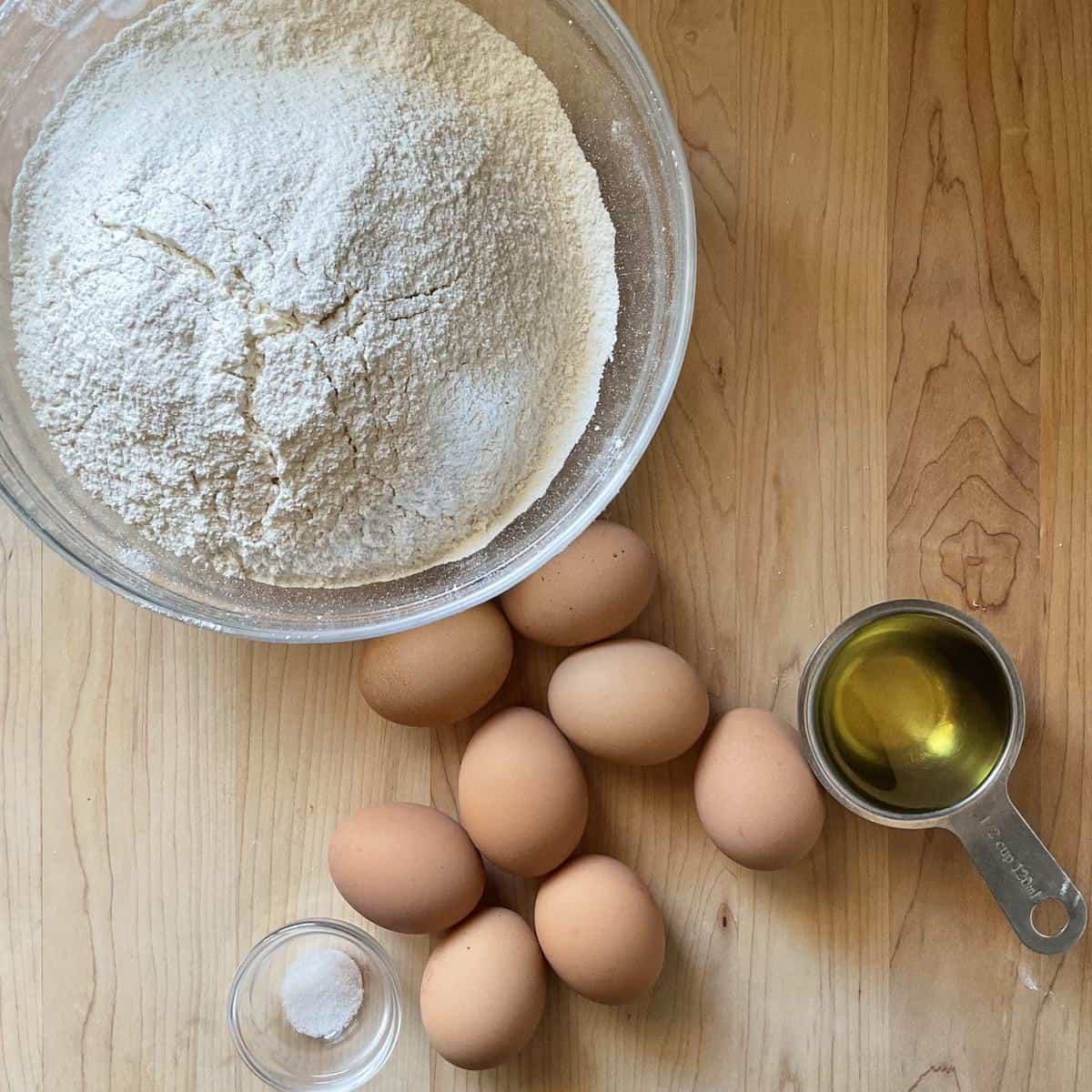
For the dough:
- Eggs: Room-temperature eggs provide structure and richness to the dough.
- Vegetable oil: I prefer vegetable oil, but you can easily use olive oil.
- Salt: A small amount of Kosher salt is all you need to enhance the flavor of the dough.
- All-purpose flour: All-purpose flour forms the base of the dough.
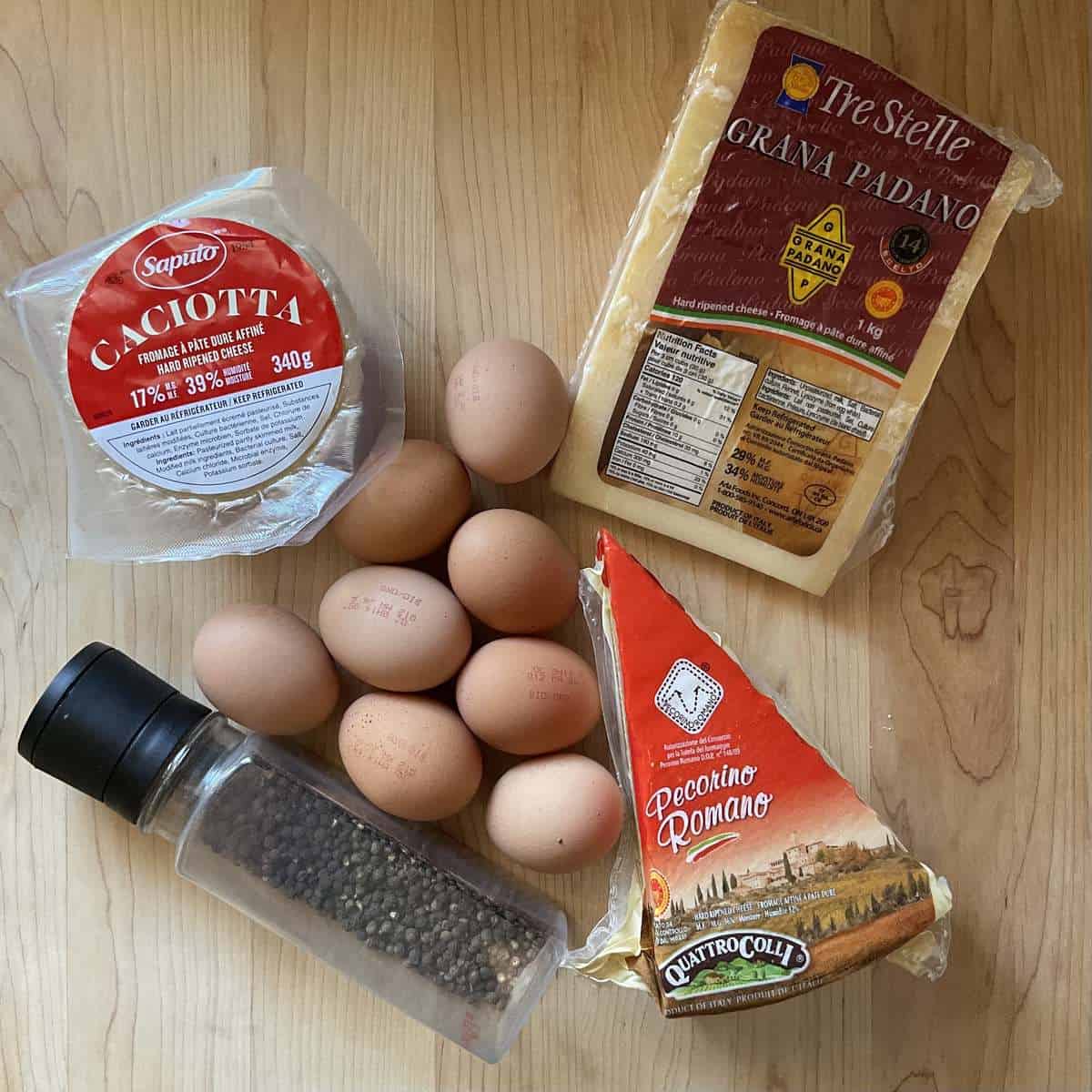
For the cheese filling:
- Caciotta cheese: Caciotta cheese adds a creamy texture and mild flavor to the filling, complementing the other cheeses.
- Parmigiano Reggiano cheese: Parmigiano Reggiano cheese has a rich, nutty flavor.
- Romano cheese: Romano cheese contributes a sharp, tangy flavor to the filling, adding complexity to the taste profile.
- Eggs: Eggs bind the filling together and help it to set during baking.
- Pepper: Use as much or as little as you like.
- Parsley (optional): Italian parsley brightens the flavors of the pie. Please note that this is an optional ingredient.
Let’s prep the fiadone recipe
Let’s start by preparing the dough, which must rest for 30 minutes.
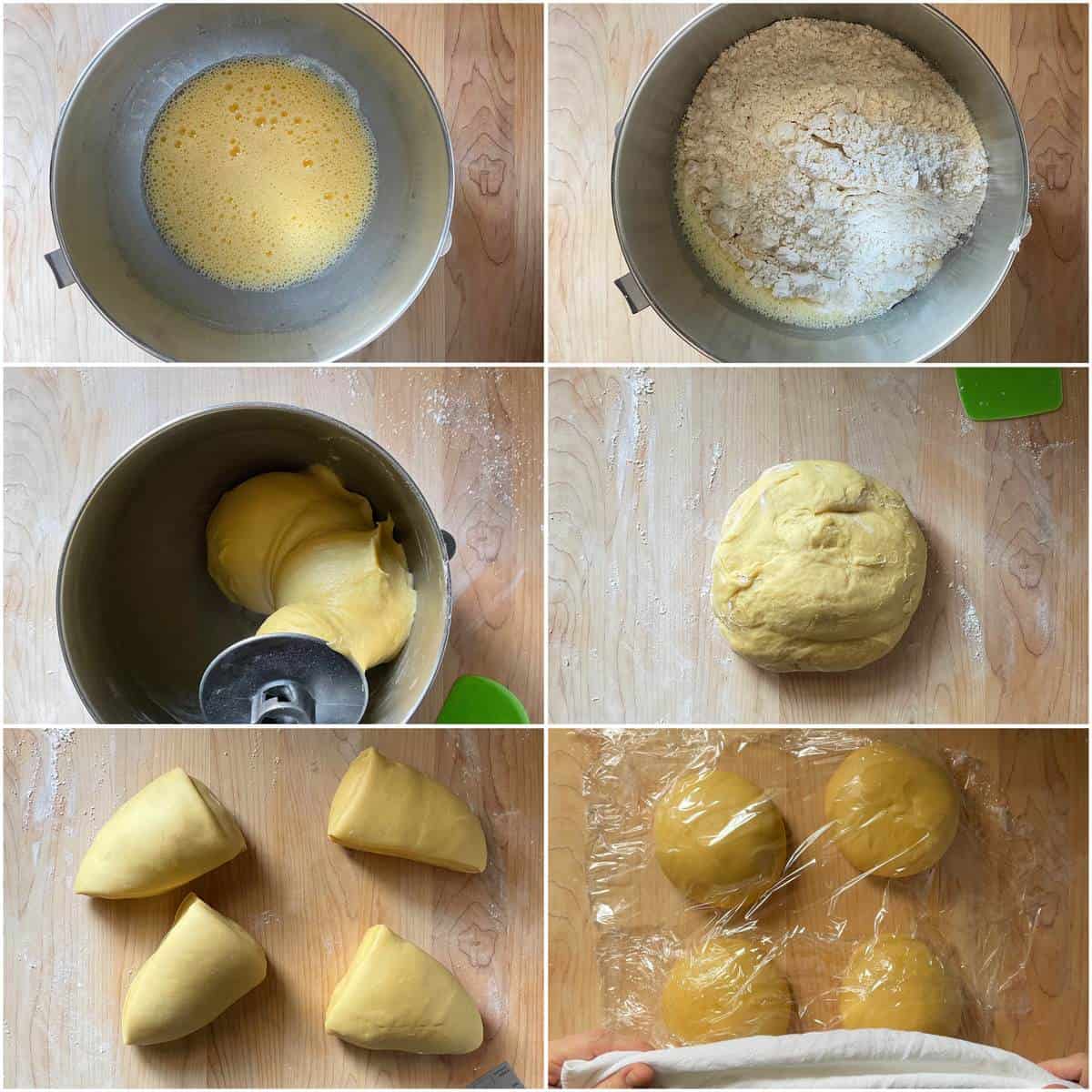
- In a large bowl of a stand mixer, whisk together 8 eggs (room temperature), 8 tablespoons of vegetable oil, and ⅛ teaspoons of salt until well combined.
- Switch to a dough hook. Gradually add 710 grams of all-purpose flour (5 cups) and “knead” the dough for about 8-10 minutes until smooth. It should pull from the sides of the bowl. Alternatively, you can knead by hand.
- Place the dough onto a surface dusted with a light layer of flour. Divide the dough into 4 equal parts. Shape the dough into balls.
- Cover the dough with plastic wrap and allow to rest at room temperature for at least half an hour.
Next, let’s prepare the cheese filling.
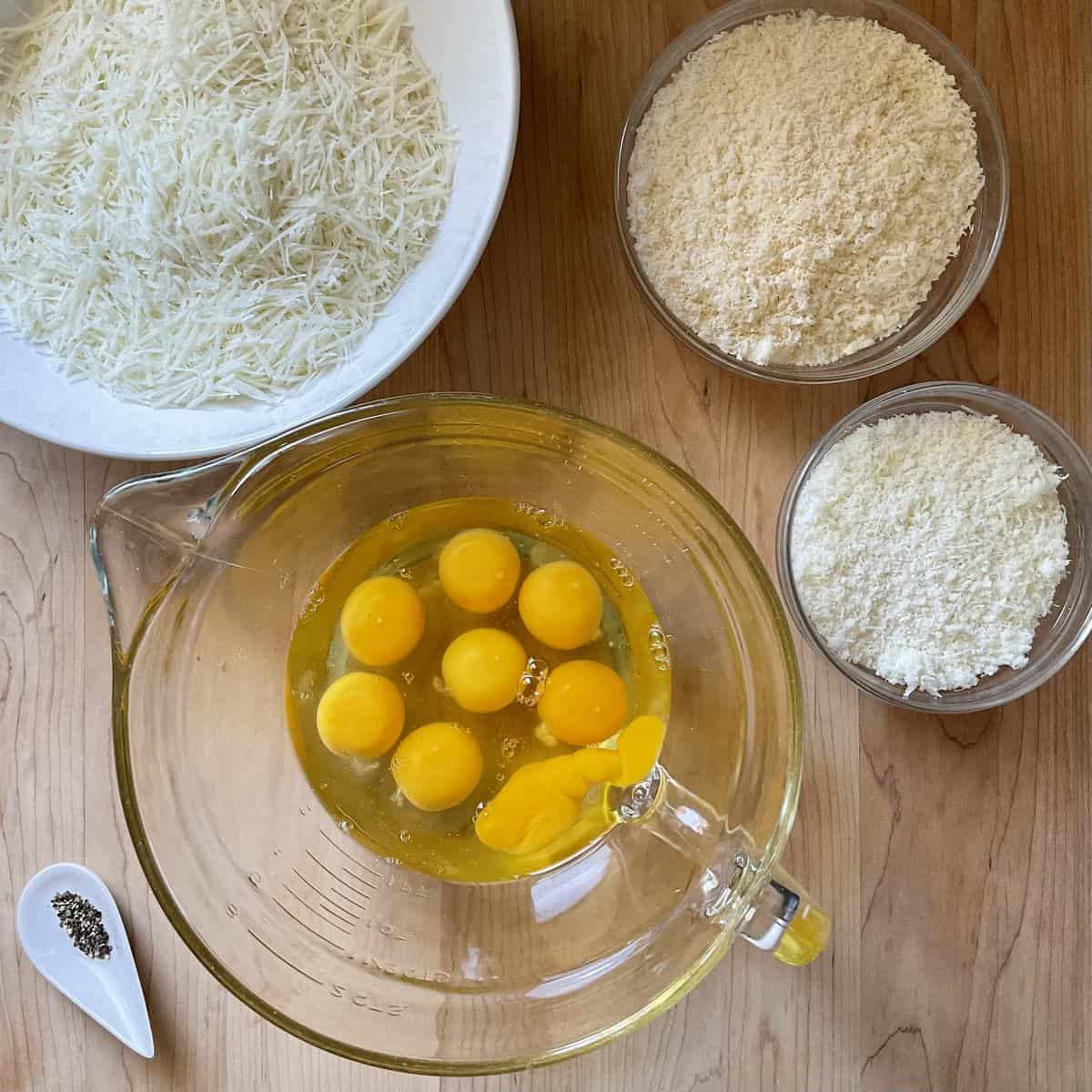
You will need to grate 200 grams (about 3 cups) of Caciotta cheese, 120 grams (about 2 cups) of Parmigiano Reggiano cheese, and 75 grams (about 1 cup) of Romano cheese. I use a box grater’s medium grate for the Caciotta cheese and the fine grate for the other cheeses.
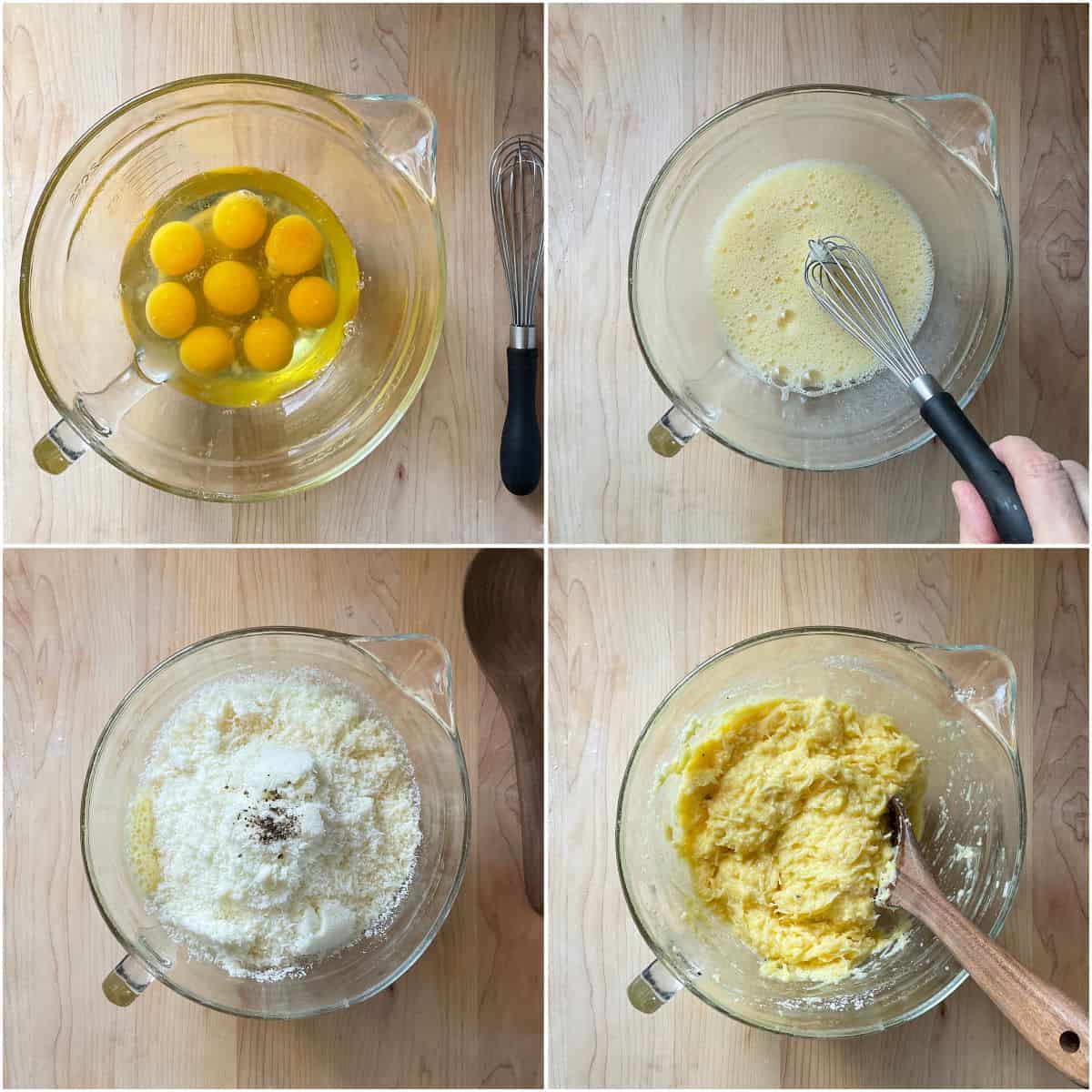
- In a large bowl, whisk 8 eggs until frothy.
- Add the grated cheeses and ¼ teaspoon pepper.
- Gently combine with a wooden spoon.
Preheat your oven to 350°F (175°C) and position the oven grate in the middle. Line a large cookie sheet with parchment paper and set it aside.
How to assemble fiadone
You will notice that assembling fiadone is similar to making calzone, as both involve enclosing a filling within the dough. Here is the procedure:
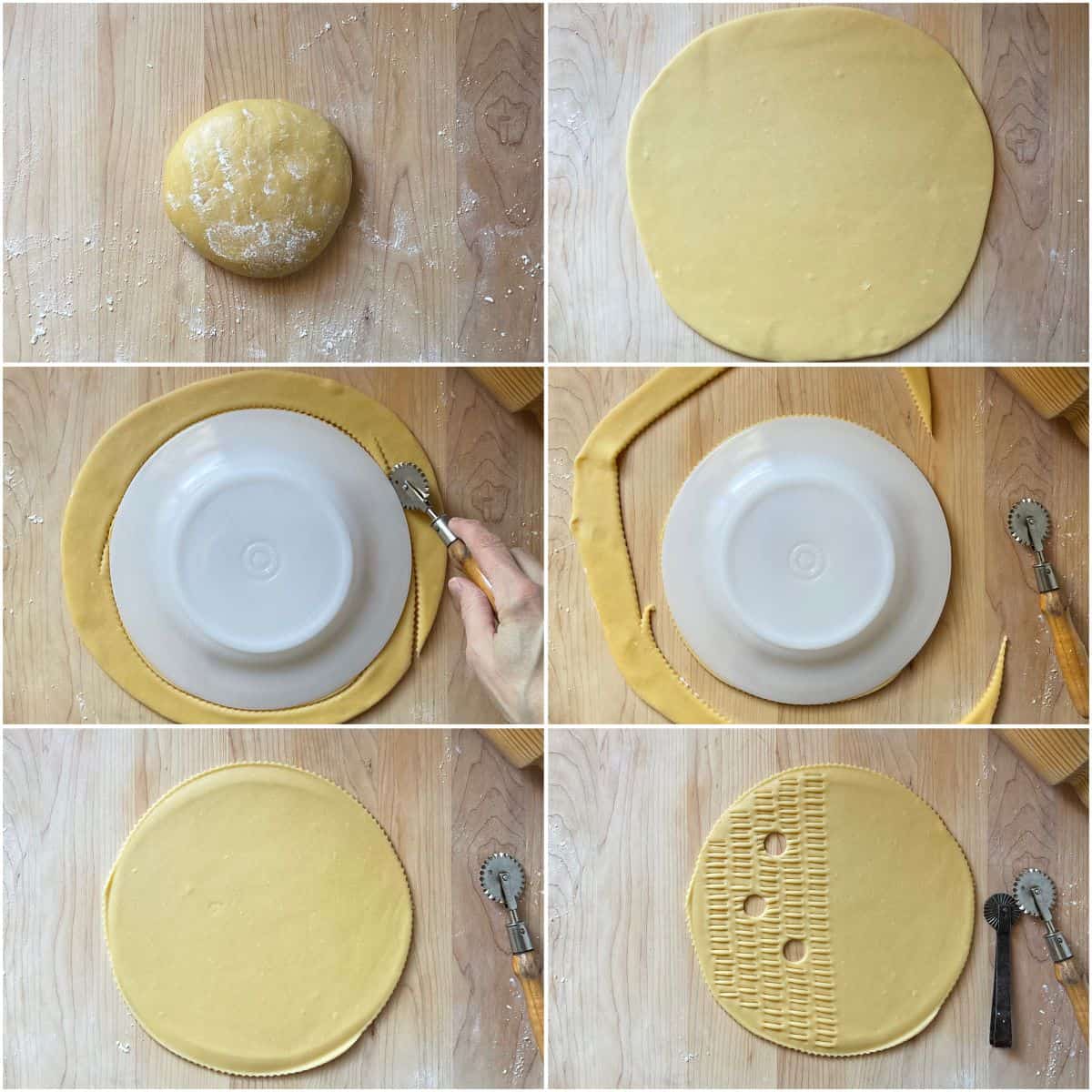
- Place one ball of dough on a lightly floured wooden board.
- With a rolling pin, roll out the dough to a circular shape about ⅛ to 3/16 inch thick, aiming for a 12-inch circle.
- Place a 9-inch plate over the dough. Cut around it with a pastry cutter to form the pie crust.
- Remove the plate.
- Make three incisions in one-half of the dough. As you can see in the picture above, I used my Nonna’s thimble to make three small air vents.
- As an option, you can pinch the dough decoratively. Remember to turn it upside down so the flat side faces up.
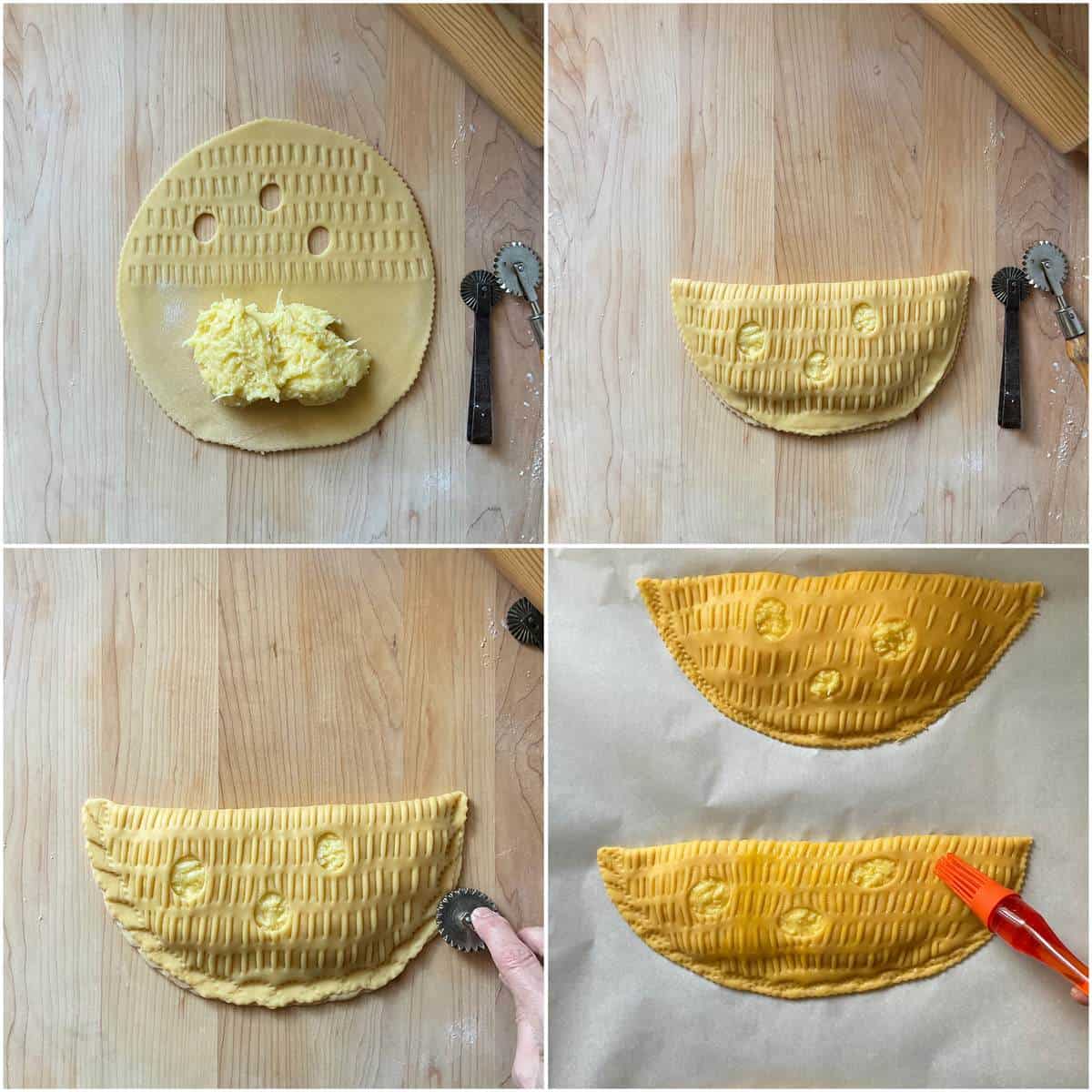
- Spoon a heaping cup of the cheese mixture onto half the dough circle.
- Fold the other half of the dough over the filling to form a half-circle.
- Seal the edges tightly with a fork or the end of a pastry cutter.
- Transfer the assembled pie to the prepared baking sheet.
- Repeat the process with any remaining dough and filling, forming additional pies.
- Brush the top of the pies with egg yolks.
- Place the pies in the preheated oven at 350°F (175°C) for about 20 minutes.
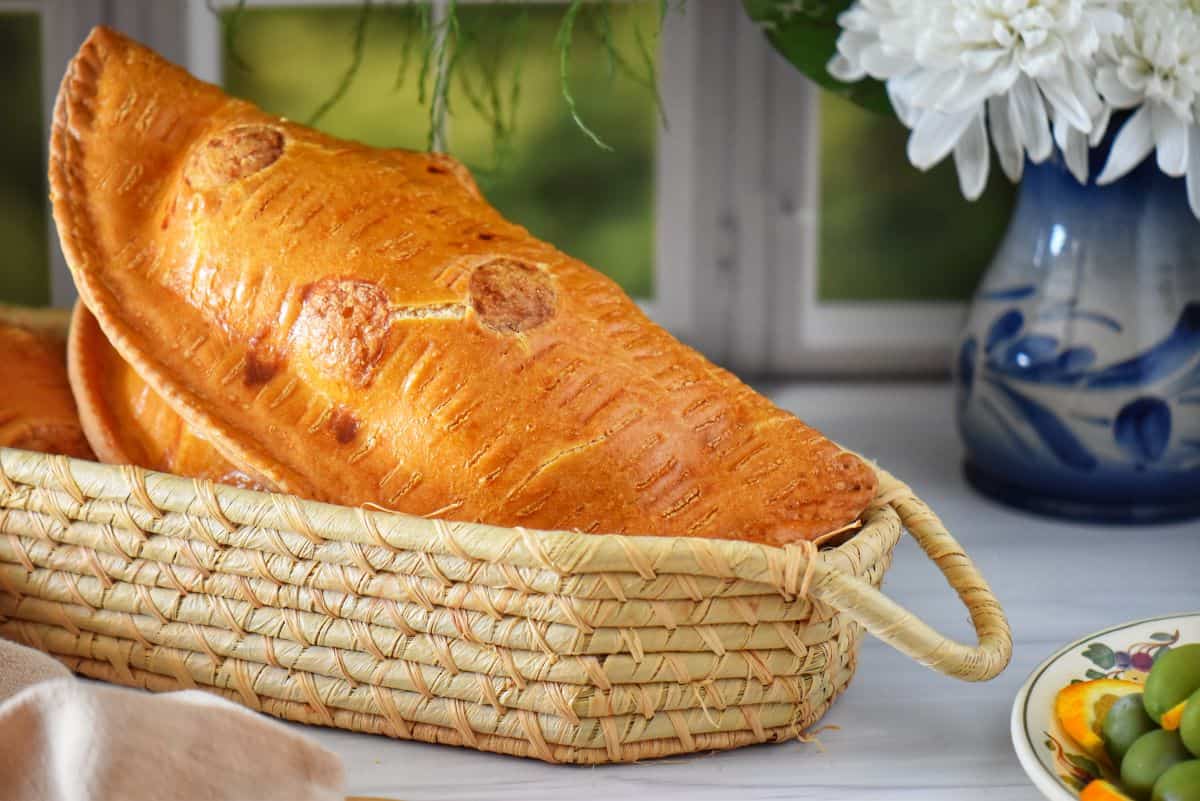
- Reduce the oven temperature to 325°F (160°C). Continue baking for 30-40 minutes or until the pies are golden and puffy.
- If needed, loosely cover the pies with aluminum foil to prevent over-browning.
- Once baked, transfer the pies to cooling racks. Cool to room temperature before serving.
Be sure to watch the video located in the recipe card for a visual representation of the recipe.
Tips
- Grate the cheese just before assembling the pies for the best flavor and texture.
- Keep the dough balls covered with plastic wrap while working on assembling the individual pies to prevent it from drying out
- Be mindful not to overfill the pies to prevent the cheese mixture from leaking out during baking. Leaving a small border also helps to prevent this.
- Ensure the edges of the pies are tightly sealed to prevent the filling from oozing out while baking.
- Brushing the pies with egg wash before baking creates a beautiful golden crust and adds shine.
FAQ
Yes. Gather the scraps of dough and press them together into a ball.
Yes, you can prepare the dough ahead of time and store it in the refrigerator for up to 24 hours. Just make sure to wrap it properly and let it come to room temperature before rolling it out.
Once cooled to room temperature, store the cheese pies in an airtight container or wrap them tightly with plastic wrap. Refrigerate for up to 1 week. For longer storage, individually wrap the pies in plastic wrap followed by aluminum foil and freeze for up to 3 months. Thaw overnight in the refrigerator.
Italian Easter Recipes
Recipe origins
Growing up Italian meant our home always had excitement and bustling activity during Christmas and Easter.
While food preparation was undeniably a focal point, it served as more than just a culinary task-it was the catalyst for cherished gatherings with family and friends, creating moments of joy and connection.
This savory Italian Easter pie is deeply rooted in regional traditions, hailing from the small town of Ripabottoni, in the province of Campobasso in the Italian region of Molise.
As with many traditional dishes, the exact rendition of this savory cheese pie can vary from one household to another. In some regions, families might incorporate sausage or ham into their pies, adding layers of flavor and texture.
However, in my family, a vegetarian version of these rustic fiadoni allows the simple yet exquisite flavors of cheese and herbs to shine.
As we gather around the table to enjoy these savory Italian Easter pies, we’re not just indulging in a delicious dish-we’re honoring our ancestors’ legacy and the family bonds that transcend time and place.
I hope these family recipes continue to be cherished and passed down for generations.
Buona Pasqua! (Happy Easter!)
THANKS SO MUCH for following and being part of the She Loves Biscotti community, where you will find Simple & Tasty Family-Friendly Recipes with an Italian Twist.
Ciao for now,
Maria
★★★★★ If you have made this recipe for fiadone, I would love to hear about it in the comments below and be sure to rate the recipe!
Recipe
Fiadone: Italian Savory Easter Cheese Pie
WANT TO SAVE THIS RECIPE?
Ingredients
The dough:
- 8 eggs
- 8 tablespoons vegetable oil
- ⅛ teaspoon salt
- 5 cups all-purpose flour 710 grams
The filling:
- 3 cups Caciotta cheese grated, 200 grams
- 2 cups Parmigiano reggiano cheese grated, 150 grams
- 1 cup Romano cheese grated, 75 grams
- 8 eggs room temperature
- ¼ teaspoon pepper
- 2 tablespoons parsley chopped, OPTIONAL
The egg wash:
- 2-3 egg yolks lightly beaten
Instructions
To make the dough:
- In a large mixing bowl (of stand mixer), with whisk attachment, beat the eggs with the oil and salt for about 1 minute.
- Switch to the dough hook and gradually add the flour.
- “Knead” dough for about 8-10 minutes. Alternately, you can knead by hand.
- Place dough on slightly floured wooden board.
- Divide dough in 4 parts. Form into a ball.
- Cover the dough balls with a plastic wrap.
- Let dough rest for at least half an hour.
- Meanwhile,you can grate the cheeses.
To make the filling:
- Grate all the cheeses, set aside.
- Whisk the eggs until frothy (about 1 minute).
- If using, add the chopped parsley.
- Gently combine with a wooden spoon. Set aside.
To assemble the pie:
- Preheat your oven to 350°F (175°C) and position the oven grate in the middle. Line a large cookie sheet with parchment paper and set it aside.
- Place one ball of dough on a slightly floured wooden board.
- With the help of a rolling pin, stretch your dough to a circular shape about ⅛- 3/16" thick.
- Place a 9-inch plate over the dough. Cut around it with a pastry cutter to form the pie crust. Remove plate.
- Create air vents by making three incisions in one-half of the dough. Be sure to watch the video for clarification.
- As an option, you can pinch the dough decoratively. Remember to turn it upside down so the flat side faces up.
- Place a heaping cup of cheese mixture in the middle section of half of your pie. (refer to picture or video). Be sure to leave a small border around the edges to prevent the filling from leaking out during baking.
- Cover and seal with a fork or with the end of your pastry cutter. Make sure you have a tight seal.
- Transfer carefully to the baking sheet.
- Brush with egg wash.
- Repeat. (I combine the leftover dough to make a fifth or sixth fiadone).
- Place in a preheated oven at 350° F for about 20 minutes.
- Lower heat to 325° F and continue baking for 30-40 minutes until golden and puffy looking. Depending on your oven, you might want to place a sheet of aluminum paper loosely over the loaves to prevent them from over-browning.
- Place on racks to cool.
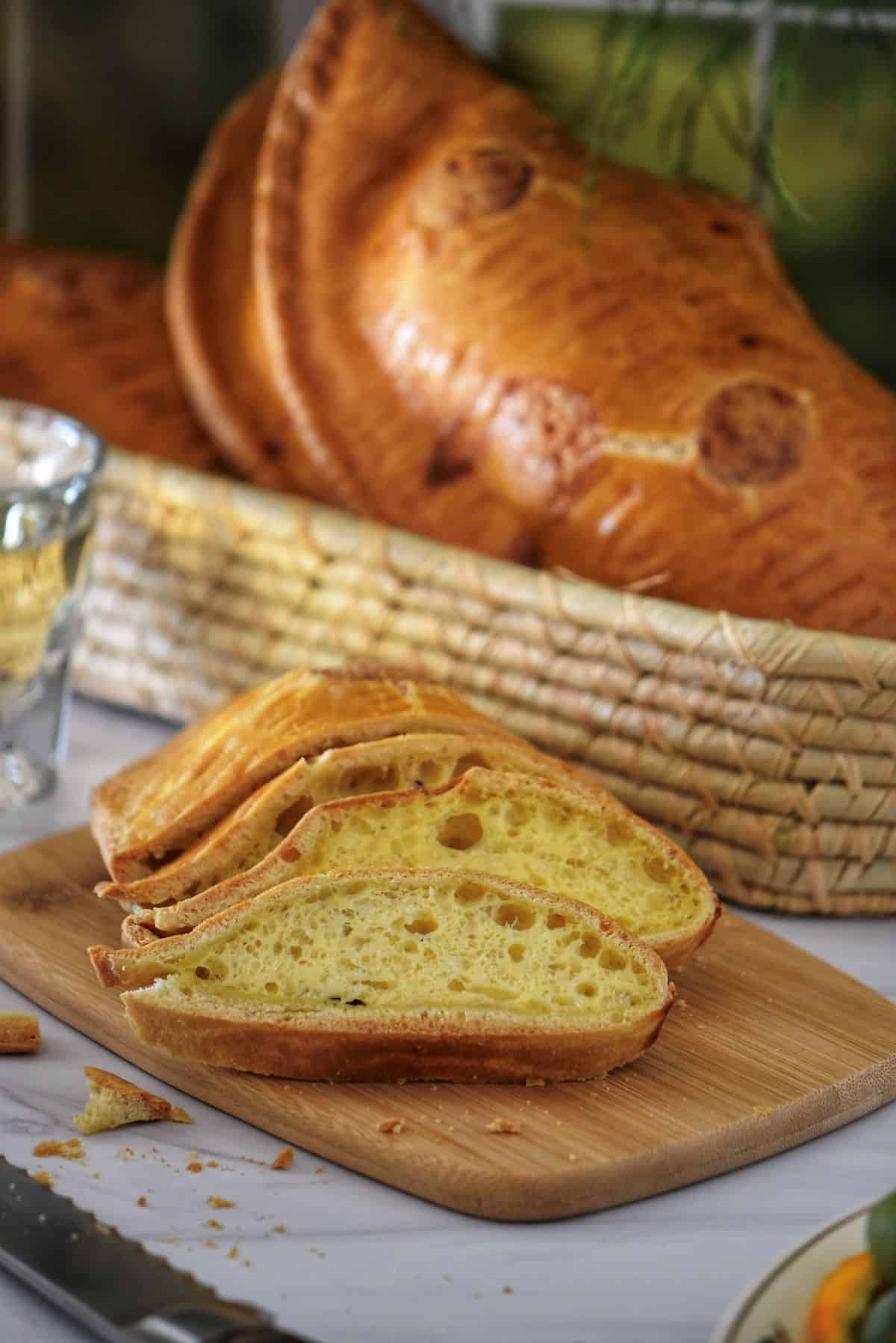
- Slice and serve at room temperature.
Video
Notes
- Grate the cheese just before assembling the pies for the best flavor and texture.
- Keep the dough balls covered with plastic wrap while working on assembling the individual pies to prevent it from drying out
- Be mindful not to overfill the pies to prevent the cheese mixture from leaking out during baking. Leaving a small border also helps to prevent this.
- Ensure the edges of the pies are tightly sealed to prevent the filling from oozing out while baking.
- Brushing the pies with egg wash before baking creates a beautiful golden crust and adds shine.
- Total yield is about 6 pies. Each pie can yield 15-16 slices.
- 1 serving = ½ inch slice
Nutrition
I originally published this post on April 4, 2015, and republished it on March 14, 2024, with updated content, pictures, and a video. Thanks for sharing
Giovanna
Thank you Maria first time making them alone and they turned out pretty good
Wishing you and your family a nice Easter safe and healthy
🌈🐣
Maria
Thanks Giovanna! Happy Easter to you and your loved ones as well!
Maggie Molle
Ciao Maria
My Mom Maria Donata Sauro was born in Rippabottoni my Nonno was Nicola Maria Sauro and my Nonna was Catherine Todaro Sauro. We are related to the Vanelli Family.
Thank you for sharing this recipe. I inherited all my Moms cook books when she passed away 12 yrs ago but never found the Fiadone recipe she made every Easter so I am extremely happy that I found you
Wishing you a Happy Easter
Maggie
Maria
Yes! We are definitely related! Happy Easter to you and your loved ones ♥
Carmy Pizzoferrato
My mother was from Casacalenda as well as both my grandparents! Last name Di Tulli. Fiadone was made in the same manner and was a staple at Easter.
Maria
How wonderful Carmy! Thanks for sharing! Happy Easter!!!
Maria
Maria,
I love your website! I have been searching for this recipe for years! I can not wait to make this. My mother was born in the Campobasso Province. She made Fiadone and Ricotta Rice Pie, (with no written recipes of course!) Thank you so much for sharing these recipes!
Maria
Maria
My pleasure Maria! Enjoy!
Maria Spause
Maria,
I made this today and I just have to thank you again for your recipes. It turned out exactly how I remember my grandmother and mothers tasting! I have not tasted this in more than a decade and it literally brought me to tears! Happy Easter!
Gratefully,
Maria
Maria
How wonderful Maria! I am so happy to read this. Happy Easter to you and your loved ones ♥
Luigi
Maria,
My grandparents came from Ripabonni as well and family name is Vannelli /Carmosinno surname “Giorgonne” any relation, figuring there are many Vannelli’s….I crave the Easter pies….
Maria
Nice to “virtually” meet you Luigi. My nonno’s surname was “Remegilde”. I vaguely remember my grandparents making reference to yours… Yes, you are right, there are a few Vannelli’s… my grandparents immigrated to Montreal in the early 50’s.
I am sure you have so many wonderful memories associated with these Easter pies. Thanks so much for stopping by.
Liana
Hi Maria,
My parents too came from provincia di Campobasso: my dad’s family was/is from Castrpignano and my mother’s family was/is from Castropignano and Roccaspromonte.
Thanks so much for posting this recipe! I didn’t think I would find an English recipe for fiadone! My mom used to make the savoury, sweet and sometimes put sausage in it. My favourite was the sweet. Have you ever heard of “pastiera”? My mom used to use the crust for fiadone but the filling was a sweet rice and milk mixture (almost like a flan).
So glad I found this site!
Maria
Thanks so much Liana. I’m happy to “virtually” meet you.
Yes, sometimes my paternal grandmother would put sausage in it.
Oh, I love pastiera… my mom’s rice ricotta Easter pie is one of my favourites. Recipe can be found in the index.
Thanks so much for stopping by!
Wishing you and your loved ones a Happy Easter.
Alexa
Ciao. What type of cheese is caciotta most comparable to? I’ve definitely never seen it in our local stores, even specialty stores. Hope to hear back. Grazie mile.
Maria
Hi Alexa, it’s a semi-soft cheese. Although I have never tried, I would think that replacing it with another similar type of cheese should provide excellent results.
One reader recently shared her experience by substituting with Friulano cheese.
Wishing you and your loved ones a Happy Easter.
Mary Stacey
Made a batch yesterday and are very tasty but again some of them puff up so much . I do not understand why. I will eat those but not nice to serve to company. Oh well they still taste good.
Julie
Our family is from guardiaregia campobasso ! We make these but slightly different we use lemon ! Love the Easter traditions
Maria
Hi Julie! Nice to « meet » you! I think I would love the addition of lemon. Wishing you and your loved ones a Buona Pasqua!
Sally Orsine
What can you use instead of caciotta cheese, I can’t find it here in Youngstown or Boardman Ohio
I just found your website and I love all your recipes. Thank you so much .!!!!
Maria
Thanks so much for your kind words Sally. I’ve asked around and no one provided me with a definite replacement. I don’t feel comfortable suggestion something I haven’t tested out for myself. Perhaps a reader can provide suggestions.
Wishing you and your loved ones a Happy Easter!
Cathy De Santis
Hi there, my in-laws were from Casacalenda & Provvidenti & fiadone was part of their Easter traditions too. Since I started to make them a few years ago I use friulano cheese with the Parmesan & Romano cheeses & it’s a big hit. Friulano is easy to find in grocery stores. We like it very sharp so I decreased the Parmesan & increase the Romano.
Maria
Thanks so much for sharing this information. I will definitely give this cheese combination a try.
Wishing you and your loved ones a Happy Easter.